

Water Stress in a Booming Economy
| Fichero | Tamaño | Formato |
|---|---|---|
| factsheet CF Ready_18-11-2014.pdf | 1.25 MB |
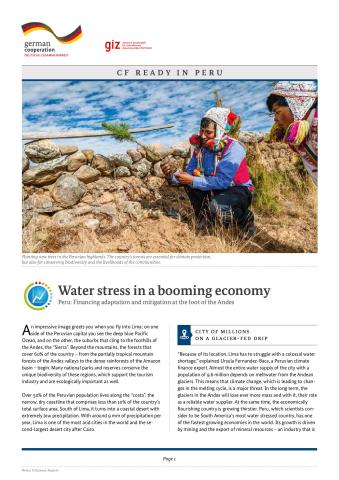
An impressive image greets you when you fly into Lima: on one side of the Peruvian capital you see the deep blue Pacific Ocean, and on the other, the suburbs that cling to the foothills of the Andes, the “Sierra”. Beyond the mountains, the forests that cover 60% of the country – from the partially tropical mountain forests of the Andes valleys to the dense rainforests of the Amazon basin – begin. Many national parks and reserves conserve the unique biodiversity of these regions, which support the tourism industry and are ecologically important as well.
Over 50% of the Peruvian population lives along the “costa”, the narrow, dry coastline that comprises less than 10% of the country’s total surface area. South of Lima, it turns into a coastal desert with extremely low precipitation. With around 9 mm of precipitation per year, Lima is one of the most arid cities in the world and the second- largest desert city after Cairo
|
Tipo de documento
|
|---|
|
Autor de la publicación o recurso
Deutsche Gesellschaft für Internationale Zusammenarbeit (GIZ)
|
|
Ubigeo INEI
|
|
Fecha de publicación
|
|
Responsable de la publicación del contenido (Editorial)
|
|
Número de Páginas
4
|
|
Idioma
|
|
País de origen de la Publicación o Recurso
|
|
Correo electrónico
giz-peru@giz.de
|
|
Derechos de acceso
|